TL;DR – The Quick Answer
- XHS is a Decision Engine: Malaysian consumers use Xiao Hong Shu (Red Note) to verify products. They trust peer reviews over brand ads.
- The “Seeding” Strategy: Success comes from “planting grass” (Caozhong)—deploying 20-50 micro-influencers to flood search results with authentic reviews.
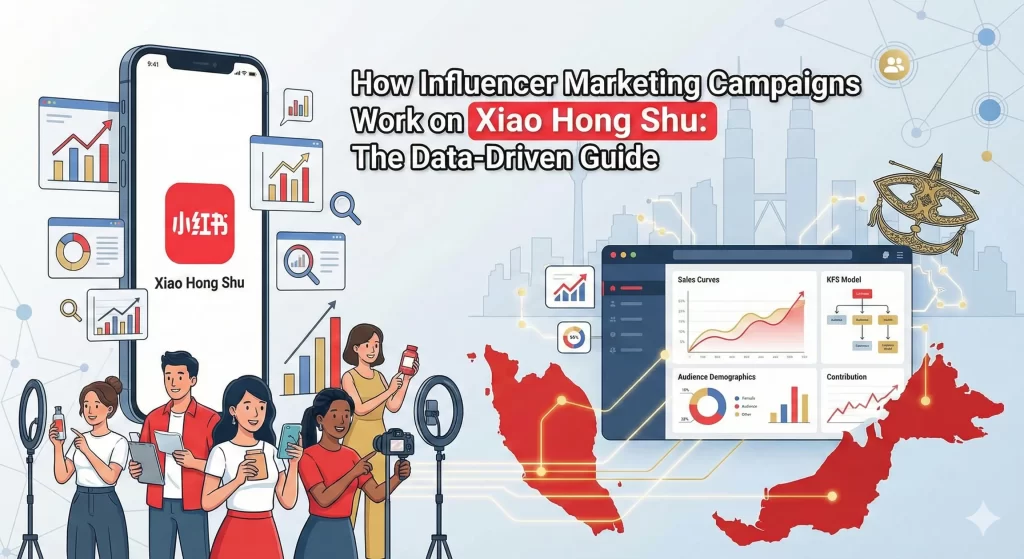
- The KFS Model: The winning formula combines KOL content (creation), Feed advertising (amplification), and Search keyword optimization (conversion).1
In our experience at IP Media Production, we often see business owners treating Xiao Hong Shu (XHS) like a typical photo-sharing app. They post aesthetically pleasing photos and wait for the leads to roll in.
This is a fundamental misunderstanding of the platform.
In Malaysia, XHS has evolved into a powerful search engine for decision-making. Your customers are not just scrolling; they are actively searching “Is [Brand X] good?” or “Best service for [Problem Y] in KL.” If your brand is silent during this search phase, you are invisible.
This guide breaks down exactly how influencer marketing campaigns work on XHS, moving beyond surface-level “likes” to the data mechanics that drive business growth.
1. The Core Mechanic: “种草” (Seed Planting)
If you understand one concept about XHS, it must be 种草 (planting grass). This is the psychological driver of the platform.
On other platforms, content disappears after 24 hours. On XHS, content is evergreen. A review written today can still drive customers to your store six months from now if it ranks for the right keywords.
How It Works:
Instead of spending your entire budget on one expensive celebrity (who might not convert), a “Seeding Campaign” distributes that budget across 30-50 KOCs (Key Opinion Consumers).
- KOCs are everyday users with 500 to 5,000 followers.
- They are viewed as peers, not paid billboards.
- The Goal: When a user searches for your product, they see a “wall” of positive reviews from different real people. This creates Social Proof Density.
Expert Insight: “One viral post is luck. Fifty consistent reviews are a reputation.”
2. The KFS Model: The Engine of Top Campaigns
At IP Media Production, we don’t rely on guesswork. We implement the KFS Model—the industry-standard framework for high-performance XHS marketing.
K – KOL/KOC (Content Creation)
This is the spark. We identify influencers who match your exact niche (e.g., “business owners looking for tax software” or “homeowners in Penang”).
- The Brief: We don’t want scripted ads. We want “User Generated Content” (UGC) style reviews that highlight a specific pain point and how your product solved it.
- Local Context: The most effective content in Malaysia often uses a “Rojak” style—natural, conversational language that blends Mandarin with local English or Malay terms.
F – Feed (Information Flow)
Once the KOCs post their reviews, we watch the data. Which posts are getting high organic engagement?
- We use Feed Ads (native advertising) to boost the best-performing posts.
- This amplifies the content to a broader audience who matches your customer profile (e.g., age 25-40, located in Klang Valley, interested in finance).
S – Search (Search Occupation)
This is where the sales happen.
- After seeing the content in their Feed, users will search for your brand.
- We bid on Search Keywords to ensure your official account or the top KOC reviews appear https://www.google.com/search?q=%231. This closes the loop from “awareness” to “intent.”
3. The AI Data Difference: Avoiding the “Fake Follower” Trap
A major roadblock for SMEs is choosing the wrong influencers. Many profiles look popular but are filled with “zombie fans.”
Here is where IP Media Production changes the game. We use AI-driven analytics to vet every partner.
Predictive Influencer Matching
We look deeper than follower counts. Our systems analyze:
- Audience Sentiment: Are the comments genuine questions (“How much is this?”) or bot spam (“Nice pic!”)?
- Active Fan Ratio: An influencer with 5k followers and high interaction is more valuable than one with 50k followers and zero comments.
- Geo-Location: For a local service business, we ensure the influencer’s audience is actually located in Malaysia, not overseas.
| Metric | Traditional Marketing | IP Media AI-Driven Approach |
| Selection | Based on “Vibes” & Follower Count | Based on Engagement Rate & Audience Data |
| Content | “Post this script.” | “Here is the USP; tell your authentic story.” |
| Success Metric | Likes & Views | Save Rate, Search Volume, & CTR |
4. Information Gain: The “Saved” Metric
Here is a unique insight for your strategy: On XHS, “Saves” are more valuable than “Likes.”
When a user “Likes” a post, they appreciate it. When they “Save” (or Star) a post, they intend to use it.
- A high Save Rate signals to the XHS algorithm that your content is high-value.
- Our Strategy: We explicitly design content that is “Save-worthy.” This includes educational carousels, checklists, or “How-To” guides relevant to your industry.
Frequently Asked Questions (FAQ)
Q: Do I need a massive budget to start on XHS?
A: No. Starting with a KOC seeding campaign is cost-effective. You can build significant brand trust with a budget of RM3,000 – RM5,000 by leveraging micro-influencers rather than celebrities.
Q: My business is B2B or a service. Is XHS only for beauty products?
A: Absolutely not. XHS users are hungry for knowledge. Accountants, interior designers, and consultants are gaining huge traction by sharing educational content (e.g., “5 Mistakes SMEs Make in Marketing”).
Q: How do I measure if it’s working?
A: We look at Search Uplift. If your campaign runs in March, and searches for your brand name double in April, the campaign is successful. We also track direct inquiries via DMs.
Q: Why choose IP Media Production over a freelancer?
A: Freelancers can post content, but they rarely have access to the data tools required to analyze keyword trends, competitor bids, and audience overlaps. We bring the science to the art of marketing.
Suggested Internal Links
- For customized strategy: Check out our Digital Marketing Services
- For visual impact: See our Video Production Portfolio
- For immediate traffic: Learn about our Paid Ad Services